


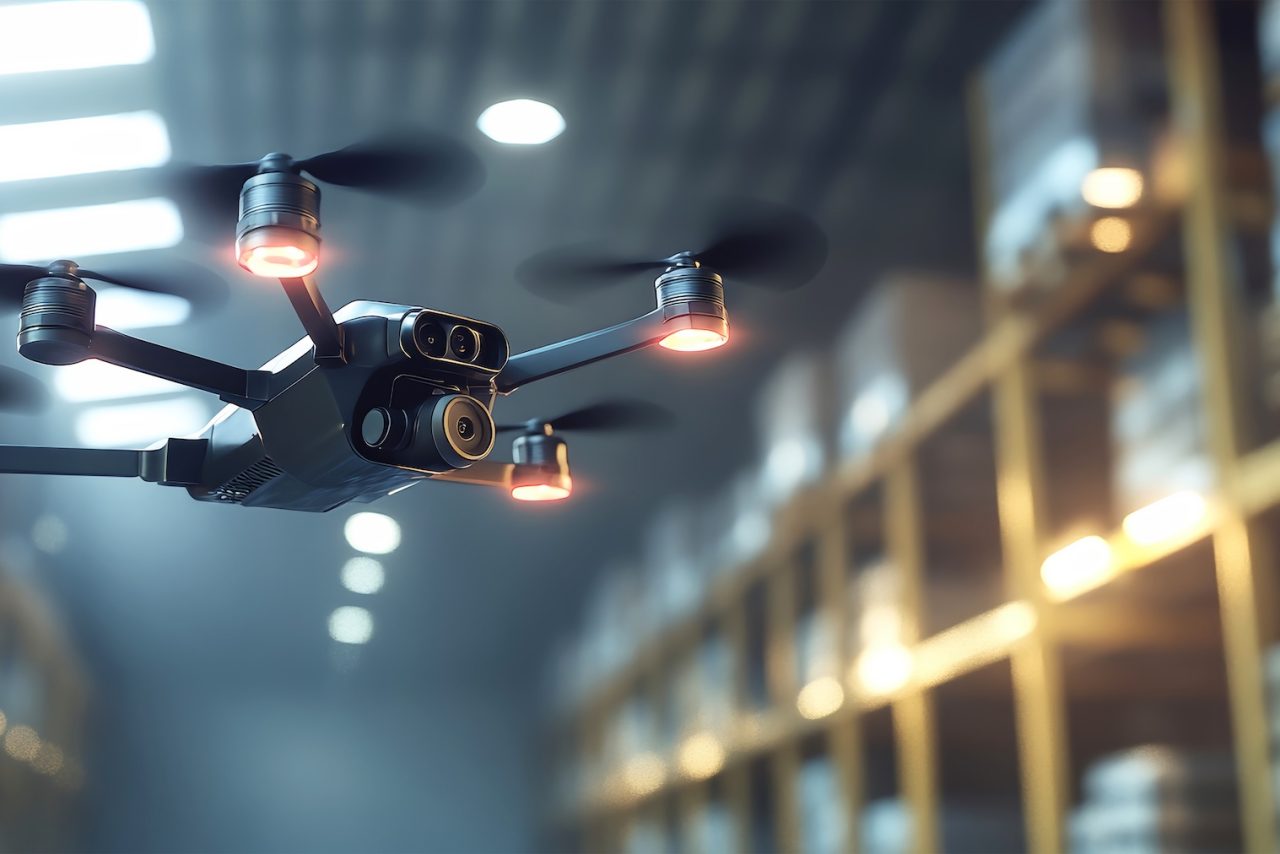
Warehouses are gradually undergoing a shift in perspective in the world of logistics, not just figuratively, but literally. Indeed, our gaze is increasingly going up to the ceilings where a new generation of autonomous drones are being deployed for concrete strategic applications for day-to-day routine. Whether they are running stock-taking checks or inspecting hard-to-access areas, these small vehicles are proving to be precious instruments that boost efficiency, deliver accurate data and raise safety levels. This is particularly true because drones are being joined by a huge quantity of extremely sophisticated ancillary technology and solutions.
HOW THEY GET THEIR BEARINGS
Unlike traditional drones designed for outdoor operations, warehouse devices were meant for complex indoor environments where there is no GPS signal and where they need to navigate tight spaces. To get their bearings, they rely on advanced technology such as SLAM (Simultaneous Localisation and Mapping), LiDAR sensors, 3D vision and artificial-intelligence systems able to recognise barcodes, QR codes or RFID tags. This enables them to move around the aisles autonomously, constantly aware of their position as they scan shelves and identify crucial information for warehouse management.
FROM STOCK-TAKING TO SAFETY STANDARDS
Deployment of drones in intralogistics occurs primarily in three areas: running stock checks, making structural inspections and increasing safety. In the first case, drones fly over stock counting inventory without disrupting operations, drastically reducing the time required traditionally while gathering and transmitting extremely precise data. As far as inspections are concerned, these flying vehicles are a safe rapid way to monitor high racking, electrical equipment or other structures that are tricky to reach. This does away with the need to employ staff members who previously clambered up ladders or climbed onto lifting platforms. Drones accomplish these tasks very well, even in external spaces, if they need to check large infrastructure, for instance. As for safety and security reinforcement, some depots use drones to monitor critical areas, detect unauthorised access, or check facilities or premises at night-time or the weekend.
USE CASES
There is no shortage of actual cases in point. Systems have been designed to automate inventory taking in warehouses up to ten metres in height and the results are astounding. The time required to carry out this work has dropped by 90% and precision levels are better because manual errors have been eliminated. Even international large-scale distribution players have tested drones, getting them to conduct day-to-day stock-taking activities; operations that once took weeks can now be done in a few hours by a small flying vehicle.
The most modern drones can be integrated with warehouse management systems (WMS), updating goods availability and location in real time. Some can even operate entirely independently throughout the night or on bank holidays so that daytime activities are not impacted. In addition to retrieving data, some devices are actually able to interpret information and detect discrepancies and anomalies, such as empty shelves, badly positioned items or incorrect codes, serving as a means of inefficiency prevention and quality control. Here too, interoperability is fundamental and the machines need to talk to each other, exchanging information so that they can “activate” an operation.
SOME LIMITS
Naturally, drones still have some limits. Although progress is being constantly made, the batteries have a short life (between thirty and forty minutes) although automatic charging stations are already in existence. What is more, the initial investment required to buy the hardware, software and infrastructure is an entry hurdle, especially for smaller businesses. Lastly (but not in order of importance), there is the regulatory aspect of the issue. It is worth pointing out that no single rule book exists for confined-space drones, leaving room for uncertainty; this puts a damper on the sector and momentarily curbs widespread drone deployment.
THE FUTURE OUTLOOK
Despite all this, the future is promising. It is expected that drones will be used extensively in vertical high-density warehousing where manual operations are especially tricky and fraught with risk. The evolution of onboard technology, longer battery life and the development of more flexible business models (like rental or pay-per-use pricing) as well as a clearer legal framework are factors that will make the use of drone fleets more accessible to all.
In conclusion, autonomous drones are becoming an integral part of the digital transformation of warehousing. Quite literally, and not just metaphorically, they provide us with a brand-new point of view of logistic operations, making them quicker, safer and more efficient. In a scenario where flexibility and resilience are absolute prerequisites, these flying assistants give a definite competitive edge and are set to be key players in our future.